

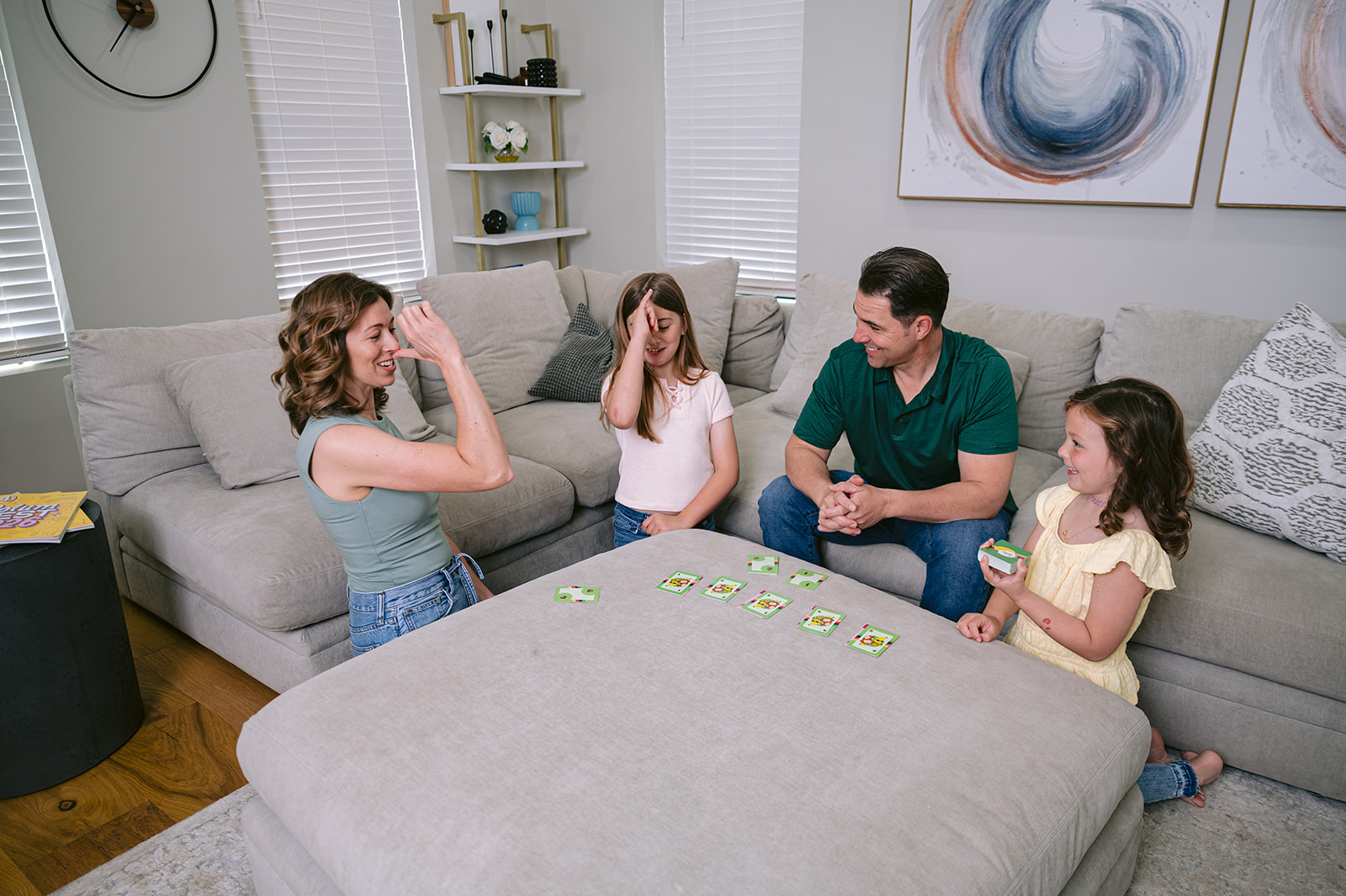
You may have heard the saying, “Families that play together, stay together.” It sounds easy in theory, but if your first attempt at family game night ended in yelling, tears, heartbreak, and sibling fights of epic proportions, you might be tempted to never, ever try again.
The problem is that most family game nights don’t come with a user manual (we made one for you anyway). Especially when you are mixing age groups, it can be tough to find something that works across levels. Let’s take a closer look at how to choose age-appropriate games for every stage.
Why Age Ratings Actually Matter (and When to Ignore Them)
Most card games come with an age recommendation on the box. Younger kids are still developing the cognitive skills to follow multi-step rules, manage strategy, or handle the emotional swings of winning and losing. A game that’s too complex can lead to frustration for kids and adults alike.
That said, age ratings are guidelines, not rules. A confident 5-year-old who already loves card games might be totally ready for something rated 7+. Similarly, a group of teens who’ve never played anything beyond Go Fish might need to start simpler than their age would suggest.
A few things worth considering beyond the box rating:
- Attention span: Shorter games work better for younger kids, while older players can typically enjoy longer games, shorter rounds, and everything in between.
- Reading ability: Games that require reading cards are tricky for pre-readers.
- Turn-taking vs. simultaneous play: Younger kids often engage more with simultaneous games where they don’t have to wait.
- Winning and losing: Younger children are still developing emotional regulation around competitive outcomes. Fast-paced, low-stakes games are typically best for a family game night.
- Group mix: A multi-generational table needs a game accessible to all, not just the majority.
With those factors in mind, here’s how to match Taco Cat games to the players at your table.
Family Games for Ages 5-6: Simple, Tactile, and Fast
At this age, kids thrive when gameplay is immediate and easy to grasp. They need action, bright visuals, and something satisfying to grab or touch. While most family games are rated 7+, here are a few that younger children may enjoy:
Steal The Bacon!
Steal The Bacon! is one of the best fits for this stage (while still keeping older children engaged). Players flip cards while chanting “Steal the Bacon!” and race to snatch the irresistibly squishy toy bacon in the center of the table when they spot a match. There’s no reading required, the physical element keeps little hands engaged, and each round wraps up in seconds.
What makes this game work for the 5-6 age group:
- The squishy bacon toy is an instant hook for younger kids.
- No strategy needed (just pure reaction and matching).
- The highly visual game elements mean no reading skills are required.
- Rounds are fast enough to hold short attention spans.
- The chanting element makes it feel more like a game than a chore.
Jelly Fish Toast & Jam
Jelly Fish Toast & Jam is another strong pick here. The card art is charming, the puns are funny for older groups, and the collect-and-steal mechanic is intuitive enough for even very young players.
Family Games for Ages 7-8: Ready for More Rules, Still Needs Speed
Around age 7 or 8, kids can start handling a few more rules without losing interest. They’re also developing faster reaction times and a greater appetite for mild competition. This is the perfect window for games that reward quick thinking without requiring complex strategy.
Taco Cat Goat Cheese Pizza
Taco Cat Goat Cheese Pizza shines brightest here. Players flip cards, chant the sequence (Taco, Cat, Goat, Cheese, Pizza), and slap the pile when the spoken word matches the card shown. Special cards (narwhal, groundhog, gorilla) have specific actions that create excitement and chaos. It takes about five minutes to learn and creates immediate family fun.
What makes this game work for the 7-8 age group:
- The chanting keeps everyone verbally engaged, not just watching.
- The special-action cards add variety and surprise without adding complexity.
- Kids 7 and up can genuinely compete with adults (reaction time is a great equalizer).
- It’s short enough for a school night but addictive enough that everyone wants to keep going past bedtime.
Moose Match Mayhem
Moose Match Mayhem also lands well in this range. The chant-and-flip mechanic is similar in spirit to Taco Cat, and the Great North theme gives it a goofy charm that resonates with this age group. First to collect three animal sets wins, but Yeti and avalanche cards keep anyone from running away with the game too easily.
Bing! Bang! Boom!
Bing! Bang! Boom! is another strong pick. The race-to-ditch-your-cards firework theme feels fresh, and the simultaneous play keeps tweens from tuning out while waiting for their turn. It’s fast, it’s loud, and it has the “just one more round” pull that this age group responds to.
Family Games for Ages 8-12: The Tween Sweet Spot
This is arguably the easiest age group to shop for when it comes to games. Tweens can handle more nuanced rules, enjoy light strategy, and love anything with a competitive edge. They’re also old enough to appreciate humor, so the weirder the theme, the better.
Points for Everything
Points for Everything is a fan favorite for this stage. Players draw from 288 pre-shuffled cards across five categories (“You,” “Everyone,” “Majority Rules,” “Timer,” and “Keep”), completing silly tasks and interactive challenges to earn points. Move your pawn along the board, and the first to hit 100 points wins. The eight included pawns feature all the original Taco Cat Goat Cheese Pizza characters, which is a fun detail for fans of the brand.
What makes this game work for the 8-12 age group:
- Five card categories keep every turn feeling different, so no two rounds play out the same way.
- The points-based board game format gives tweens something to track and strategize around, without making the rules complicated.
- Silly challenges and group tasks create genuinely funny moments that this age group loves to talk about afterward.
- Designed for 3-8 players with games running 20-30 minutes. This sweet spot is long enough to feel satisfying, but short enough to fit a few rounds into a game night.
- Players ages 8 and up can fully participate without adult help.
Stack Nabbit
Stack Nabbit is another strong pick for this age group, and it scratches a slightly different itch. It’s a push-your-luck card game where players flip cards one at a time (up to five) and decide when to stop, keeping only their last card. The twist: when you keep a card, you immediately steal all matching cards. But your cards stay exposed until you bank them, which means anyone can nab them right back on their next turn. The anticipation offers a thrill this age group can’t get enough of.
Ages 12 and Up (Teens and Adults): Performance, Strategy, and Pure Chaos
Older players want games that either challenge them mentally, get them laughing, or ideally both. Teens in particular tend to engage best with games that have a performance element (something that creates moments worth talking about after the fact).
GOAT: Greatest of All Time
GOAT: Greatest of All Time was practically built for this age group. It’s a twist on charades where prompt cards are combined with hilarious modifier cards that change how you perform the prompt, turning a simple act into something unpredictable and usually ridiculous. The group votes on who performed best, and the winner gets a wearable medal.
What makes this game work for the 12+ age group:
- The modifier system means no two rounds ever feel the same.
- It rewards creativity and commitment over pure knowledge, so the playing field is level.
- The voting mechanic creates discussion and debate, which keeps energy up between turns.
- Works beautifully for groups of 4-8, making it ideal for parties or larger family gatherings.
You know your teen best, and this stage can come with big feelings, fragility, and perhaps a dash of attitude at times. If they are a little shy or “too cool” for performance elements, it might be better to start off with more reflex-based chaos. Wild Wild Taco and the On The Flip Side Expansion Pack (which adds new cards to the original Taco Cat Goat Cheese Pizza) keep the energy dialed up for teens.
I Know…You Don’t
I Know…You Don’t offers something different for older players who enjoy a mental challenge. One player takes the role of Rule Keeper, secretly choosing a pattern that governs which cards can be played. Everyone else has to crack the code, using which cards are played or rejected as clues. The first player to figure out the rule can use it to shed their own cards, identify the secret rule, and win. It is a perfect combination of puzzle, strategy, and secrecy that older players love.
How to Include Younger Children in Family Game Night: Quick Tips for Success
All of the games mentioned above are built to work across age groups. Our key is simple rules, quick rounds, a level playing field, and chaotic fun for the whole family. However, it is also important to know what works for your crowd and introduce younger children to the fun with care. Here are some tips on successfully introducing family games to your newest players:
- Head start: While older children can pick up on the rules quickly, you might consider setting aside some extra time with younger children before getting started. Explain the rules at their learning pace, play a few practice rounds, and give them the tips they need to keep up with the big kids before family game night starts.
- House rules: Make up your own rules to help things feel more fair, exciting, and inclusive to younger children. For example, when playing Jelly Fish Toast & Jam, you might make a house rule that says players can only steal cards from the grown-ups.
- Modifications: You might also consider giving younger players a slight edge if they need it. For example, in games like Steal The Bacon!, you may consider placing the toy bacon a little closer to your youngest player. Or, in games where collecting cards is a goal, you may consider starting younger children with 1-2 extras. Get creative and decide what feels right for your family’s game night.
- Pairs or teams: While introducing new games, you might have your youngest players team up with a grown-up as they learn the rules.
Ultimately, you know what is best for your family, and games have rules for a reason. Sometimes, part of the fun is learning that losing is okay (and there is always a rematch waiting just around the corner). These are just tips and ideas for including younger children until they are ready to take off their proverbial training wheels.
Taco Cat Games: Fun for Every Age Group
Taco Cat Games has built its entire lineup around games that are easy to learn, impossible to put down, and designed to work across generations.
If you’re not sure where to start, you almost can’t go wrong with the original Taco Cat Goat Cheese Pizza. Once your crew is hooked, you have the rest of the catalog and deal-filled bundles waiting for you.
Family game night will never be the same. That’s a promise.